
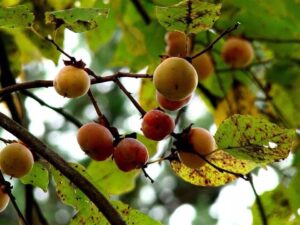
Botanical name: Diospyros virginiana
Common names: American persimmon, ‘Simmon, Sugar Plum
Family: Ebenaceae (Ebony family)
Harvest time: October-November
Uses: Food…so sweet!
Habitat and Cultivation Tips for American Persimmon Trees
American persimmons are generally found fruiting at an elevation between 700 and 2700 feet. They seem to prefer well drained soil, but are also found near creeks. These opportunistic trees do grow in forests, but they yield much more fruit when grown in the open.
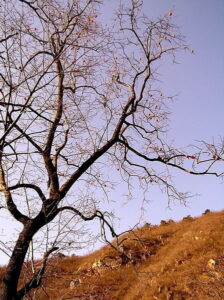
During the autumn, just after the leaves have fallen, while driving down country roads, keep your eyes open! American persimmons are the distinctively delicate trees between 10 and 30 feet tall with bright orangey-pink fruit the size of a golf-ball. They really make a beautiful show during a season when things are looking quite drab.
American persimmons are dioecious, which is a botany term that means the trees are either male or female (rather than male and female flowers on the same tree). Wild Abundance director Natalie Bogwalker learned this by observing the trees on her property. She found one particularly large and beautiful specimen, but never saw it bare fruit. Nonetheless, there were a bevy of baby persimmons growing around it, so she figured it must be their mother. After 3 years of watching the large persimmon and finding nary a fruit, she grew suspicious. During this time she also noticed a much smaller American persimmon tree on her neighbor’s property that was loaded with fruit every fall. Hmm. So, Natalie did some research. She learned that persimmons spread from root suckers as well as from seed; good information for the garden journal, and to guide management strategies into the future.
American vs Asian Persimmon
While both American and Asian persimmons are delicious, they differ in many ways. American persimmons (Diospyros virginiana) are smaller, sweeter, and more astringent when underripe. Asian persimmons tend to be larger, less astringent, and more shelf-stable, making them more commonly available in grocery stores. However, American persimmons have a more complex flavor and can withstand colder temperatures, making them ideal for native gardens and homesteads.
American Persimmon Varieties
There are several known varieties of American persimmons, some naturally occurring and others selectively cultivated. ‘Early Golden’ is one of the best-known named varieties and is prized for its early ripening fruit. ‘Meader’ is a self-fertile cultivar developed for cold hardiness. While wild persimmons vary in size, taste, and astringency, cultivated varieties offer more consistency and can be ideal for those wanting reliable harvests.
If you’ve ever wondered ‘Are persimmons edible?’ — the answer is a resounding yes, but only when they are fully ripe. American persimmons are known for their astringency when underripe, and incredible sweetness when fully soft.
Learn more about persimmon varities in our Permaculture Design Certification Course!
Special qualities of the American Persimmon Tree

Another name for the American persimmon is “sugar plum” (ever heard of the sugar plum fairy?). This name is very indicative of the qualities of the American persimmon. In fact, they are shockingly and wonderfully sweet, plus they’re about the size of a plum. As a result, eating just a few fruits can cause a sugar rush and a tingle to any sweet tooth.
American persimmons are only edible when they look like they’re about to go rotten: the skin will be very wrinkled, and the fruit itself will appear quite mushy. Furthermore, the color will be a bright orangey-pink. If you try to eat the fruit before it’s ripe, you’ll have a quite memorable experience. Unripe American persimmons (like their Asian cousins) are quite astringent, enough to make your mouth pucker quite uncomfortably.
You won’t find American persimmons in stores because they’re difficult to transport and do not keep well. Asian persimmons can usually be found in grocery stores and farmer’s markets in the fall. This is because the fruits are larger and have a longer shelf life. American persimmon trees are a bit hardier than their Asian cousins, which may not survive winters at higher elevations.
Ethnobotanical History and Gathering tips for American persimmon
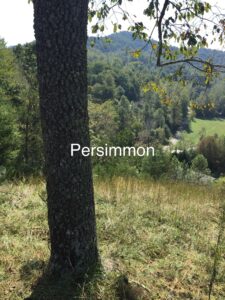
American persimmon wood is dense and beautiful. It is, after all, in the ebony family. Persimmon lumber, however, does not have significant commercial value because the trees do not tend to grow very big or very straight. Nonetheless, it does make lovely hand-carved spoons, spatulas, and knife handles.
As mentioned above, American persimmons are ripe and ready to eat only when the fruit looks like it is about to rot, around the same time acorns are ready to harvest, and it’s cool enough to savor warm chai tea. For fresh eating, it is important to let the fruit stay on the tree until it is ripe enough to fall. A good way to harvest American persimmons is this:
- Clean up under the tree, tossing any fruit that has turned sour away from the tree, and putting any fruit that looks like it is about to turn, but has not yet turned into a bucket
- Grab branches and shake, or get up in the tree and shake with your whole body. If the tree is ready, there will be a great avalanche of sweet fruit. Make sure not to look up when you shake, as you might end up with fruit, leaves, or little wood particles in your eyes.
- Gather freshly-fallen fruits in a bucket. Never use bags to gather persimmons, as the fruit is so darned mushy that it makes a big mess when squished up in a bag.
- Optional: put sheets, drop cloths, or tarps on the ground under the tree before shaking. It’s best to stay away from old tarps, as the paint and plastic can be apt to stick to the fruit, rendering it inedible…and isn’t this the whole point…to obtain the edible?
Favorite fresh American persimmon preparation
Interested in learning more about native fruits, food preservation, and wild edible plants? Join us for our Permaculture Design Certification Course to deepen your connection to the land and the seasonal bounty it offers.
Natalie never ever recommends cooking American persimmons. That’s because what she loves about persimmons is the delightfully smooth texture, and unique sweetness. Indeed, when they’re cooked, this texture turns boring, and the sweetness dissipates. Many recipe books suggest making a persimmon bread similar to a banana bread, or a cooked persimmon pudding. You can try these if you like, but we encourage you to experiment first with raw preparations that showcase the lovely uniqueness of these autumn treasures.
Grow Your Gardening Skills!
Permaculture Design Course
10 Spring Wild Foods That You Can Find Almost Anywhere
Seasonal Land-Based Living Handbook
Raw Persimmon Pudding:
6 c very ripe American persimmons
½ c heavy whipping cream, half and half, sour cream, or coconut milk
½ t salt
0-5 t honey or maple syrup, depending on desired sweetness (totally optional!)
½ t vanilla extract (optional)
¼ t ground cardamom
In order to make persimmon paste, run persimmons through a Foley food mill using the plate with the largest size holes. Alternatively, if you don’t have a food mill, pick out all of the seeds from the persimmons by hand and mush up the remaining paste with potato masher or with your hands until its shiny and smooth.
Combine all ingredients well in a bowl. Chill. Serve. Enjoy!
The pudding can be served on its own or with cookies: either shortbread, snickerdoodles, vanilla wafers, or with what are known as “galletas” in latin food stores.
American persimmon pulp can make a great addition to homemade ice cream, especially in combination with sassafras root.
American Persimmon Tree Facts
American persimmon trees can grow between 10 and 30 feet tall, often with a rounded or spreading crown. They can live up to 75 years and begin producing fruit in 4–9 years depending on growing conditions. The trees are dioecious, meaning you typically need both male and female trees unless using a self-fertile cultivar. They’re tolerant of drought, adaptable to various soil types, and attract a range of wildlife including deer, raccoons, and birds.
American persimmons are highly perishable, but their flavor and nutrients can be enjoyed year-round with a little creativity. From meads and wines to dried snacks and fruit leather, preservation is an important part of American persimmon care and homestead use.
Favorite American persimmon preservation methods
Alcoholic preservations:
Wine/melomel

Persimmon wine and mead are both awesome! Always sterilize persimmons before adding them to mead to prevent the mead turning to vinegar by some errant bacteria that has already started colonizing the ripe persimmons. To do this: pour almost boiling water over the fruit, then let the fruit and water cool before adding both to your brew bucket. Do not cook the fruit on the stove-top, as this will remove much of the flavor. A general recipe is to use one gallon of ripe persimmons per 5 gallon batch of wine or mead. It’s works well to add the persimmons to the primary fermentation. One or two cinnamon sticks, and a vanilla bean are delightful compliments to any persimmon ferment.
Persimmon Cordial
Put a cup of whole, ripe, persimmons in a jar, and pour moonshine on top. Optionally you can add a cinnamon stick, a vanilla bean, vanilla extract, a bit of wild cherry bark, and/or a quarter cup of evaporated cane juice, panela (the real evaporated cane juice that can be found in cones or cakes in latin food stores), honey, or maple syrup.
Drying American Persimmons
There are two great ways to dry American persimmons: whole, and as fruit leather. Both are excellent non-electric storage techniques for this highly perishable fresh fruit.
Whole dried American persimmons
From Natalie:
Once, years ago, my old land-mate, James Price, shared some dried persimmons that he had found that had happened to dry on the tree, in a year that happened to have a very dry fall. I found these sweet little treats to be much akin to medjool dates. I love dates, but we can’t grow them in Appalachia, so I was willing to put some energy into figuring out the drying of the whole fruit.
When drying persimmons whole I have learned to break all of the rules. I had many bad experiments with trying to dry the ripe fruit. The dried fruit looked fine, but inside the skin the fruit had turned into a somewhat tasteless brown powder. I asked around about this, and someone, I wish that I could remember who, told me that to dry the fruit of a persimmon whole, one must start with unripe fruit. This seemed counter-intuitive to me, but I tried it.
I found a persimmon tree with low hanging branches, picked some light orange, but not yet ripe fruit, and put it on the drying racks above my woodstove. After a couple of weeks, the fruit had dried, and ripened as it dried. The result was very similar to the date like treats that I had enjoyed off of a tree years before.
American Persimmon Fruit leather
In order to make fruit leather with persimmons, make a paste, the same as above in the persimmon pudding recipe. Then, spread it out onto parchment paper, and place it on drying racks above a wood stove, or on fruit leather sheets provided with most electric dehydrators. The flavor of persimmon leather can be a bit sweetly bland. A nice way to add depth to the flavor is to add in crushed Autumn olives, which lend a nice tartness to the finished fruit leather. Conveniently, Autumn olives are harvested at about the same time of year as American persimmons.
Frequently Asked Questions About American Persimmons
American persimmons (Diospyros virginiana) and Asian persimmons (most commonly Diospyros kaki) differ in size, texture, and when they’re pleasant to eat. American persimmons are typically smaller, more cold-hardy, and intensely astringent until fully ripe—meaning an unripe fruit can make your mouth feel dry and puckery almost instantly. Once ripe, though, American persimmons become jammy, custard-soft, and intensely sweet. Asian persimmons are generally larger and are often bred or selected for eating at different stages: many types are sweet and enjoyable while still firm, and they’re the ones you’re most likely to see in grocery stores. In short: American persimmons are a wild native fruit with a narrow “perfect ripeness” window, while Asian persimmons are more commonly cultivated for consistent, store-friendly eating.
Yes—American persimmons are absolutely edible, but ripeness is everything. The fruit should be fully ripe, which usually means it’s very soft, slightly wrinkled, and may look overripe compared to most other fruits. At that stage, the astringency has largely disappeared, and the flavor turns intensely sweet and rich. If you eat them too early (even if they look orange), you’ll likely get that powerful mouth-drying sensation that makes people think the fruit is “bad” when it’s really just unripe. Many folks prefer to scoop the pulp with a spoon rather than bite into the skin, and ripe pulp is also excellent in baked goods, puddings, or stirred into yogurt and oatmeal.
Yes, but only if the fruit is truly ripe—soft enough that it gives easily with gentle pressure. With American persimmons in particular, the best eating often happens when fruits fall naturally or can be easily shaken loose, because that’s usually the point when the astringency has faded. If you pick them firm or “almost ripe,” you may get that strong puckering effect that can ruin the experience. A good rule of thumb: if you have to tug to remove it, it probably isn’t ready; if it practically wants to come off in your hand (or is dropping), you’re much closer. If you’re unsure, let the fruit finish ripening at room temperature until it becomes soft and jam-like.
When fully ripe, American persimmons are intensely sweet, rich, and almost creamy—often compared to honey, dates, brown sugar, or a caramel-like fruit custard. The texture can be smooth and pudding-like, especially in fruits that are very ripe, which is why they’re famous in traditional persimmon puddings and baked desserts. The flavor is “deep” rather than bright—less like a tangy berry and more like a concentrated, warm sweetness. If there’s any dryness or mouth-puckering at all, that’s a sign the fruit still isn’t quite ready. At peak ripeness, most people find the taste surprisingly luxurious for a wild native fruit.
American persimmon fruit is usually around golf-ball size, though it can vary by tree, region, and variety—some fruits are smaller like large marbles, while others can be a bit bigger than a golf ball. The trees themselves are medium to large: in many landscapes they grow roughly 10–30 feet tall, but in good conditions they can get taller, especially when left unpruned. Growth habit also depends on whether the tree is in open sun (often shorter and more spreading) or competing in a forest edge (often taller and more upright). If you’re planting one, it’s smart to give it room not just for height, but for a broad canopy as it matures.
Learn How to Grow All Kinds of Fruits & Veggies!
Explore even more ways to incorporate native fruits and wild foods into your lifestyle through our Permaculture Design Certification Course, where we combine traditional knowledge and hands-on homesteading.
 On Facebook
 On Instagram